
Printing and embroidery
Choosing Blank Apparel for Printing and Embroidery
Prepare a blank, artwork and sample brief that your decorator can evaluate before the full order.
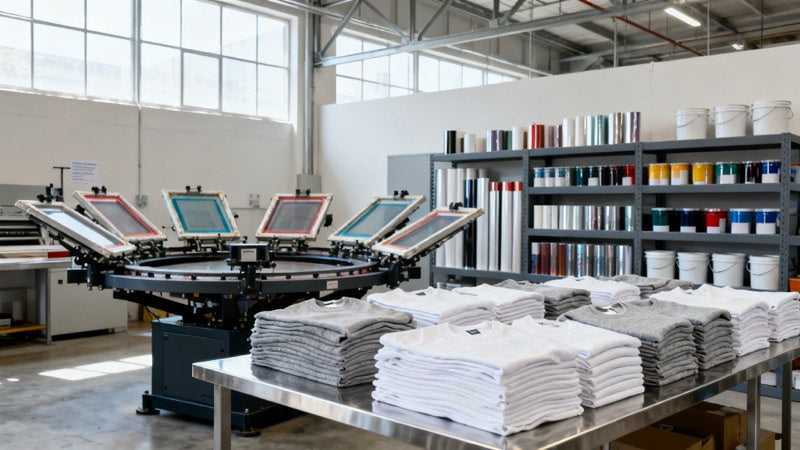
Choose the blank and decoration process together. Give your decorator the exact garment style, fiber content, color and artwork before ordering the production quantity. Then approve a sample made with the intended process. A general description such as “cotton T-shirt” leaves too many details open.
B&S Wholesale supplies the blank garments discussed here. Use this guide to prepare a purchasing and production brief for your chosen decorator; a product recommendation is not an approval of every ink, transfer or embroidery setup.
Start with the artwork and the garment
Record the final artwork dimensions, each placement, the intended colors and whether different garments need individual names or numbers. Include the original artwork file and a placement reference. A tiny logo preview on a phone does not show whether fine text or detail will reproduce at the final size.
For the garment, send a product link, style number, color, size range and composition. List any seam, pocket, zipper or hood near the decoration. Tell the decorator whether the garment will be sold, issued to staff or used for an event, and describe any specific appearance or care requirement.
Compare processes using the job you actually have
| Process | Useful question | Sample to review |
|---|---|---|
| Screen printing | How do artwork colors, print locations and quantity affect the quoted setup? | The final artwork on the chosen garment color. |
| DTF transfer | Which transfer and application instructions are specified for this blank? | The applied design, including its edge, feel and placement. |
| DTG | What garment preparation does this printer and ink system require? | The actual image on the intended fabric and color. |
| Embroidery | How will the artwork be digitized and the knit stabilized? | A stitch-out on the chosen blank, inspected front and back. |
For a closer comparison of printing processes, read screen printing vs. DTF vs. DTG. For stitched logos, use the embroidery blank checklist.
Use fiber content to ask better questions
For cotton-focused comparisons, shortlist H1003, listed as 100% ring-spun cotton. For a stretch blend, compare H1002, listed as 95% ring-spun cotton and 5% spandex. For fleece, consider H9002, listed as a 60% cotton and 40% polyester blend. These are different substrates, so do not assume approval of one covers the others.
Printer guidance can be very specific. Epson’s SC-F2270 documentation distinguishes cotton and polyester preparation and recommends testing the fabric. Apply the instructions for your decorator’s actual equipment rather than treating a generic DTG recommendation as universal. See Epson SC-F2270: Required Equipment for T-shirt Printing.
For polyester and polyester blends, ask about dye migration as well as adhesion and appearance. STAHLS explains that heat can cause garment dye to discolor a decoration, with results varying between garments. A satisfactory initial print should be assessed using the decorator’s full test procedure. See STAHLS: Dye Migration Handbook.
Approve more than a digital mock-up
- Approve the blank. Confirm the garment style, color and fit.
- Approve the artwork. Check spelling, version, dimensions and placement.
- Review a decorated sample. Examine legibility, color, hand feel and the reverse of any embroidery.
- Review after the agreed care test. Follow the garment and decoration care instructions and note any change.
- Record the approved version. Keep the sample or dated photographs and a written production brief together.
Agree who supplies the test garments and what happens if the sample needs another blank or another process. Include that step in your timeline instead of assuming a proof image is production approval.
Turn approval into an order
Before releasing the full quantity, confirm sizes and selling units using the pack guide. Ask the decorator for a production schedule based on confirmed garment availability, artwork approval and receipt of the blanks.
Explore blank T-shirts and fleece, or request samples for evaluation. The buying guide covers the initial garment shortlist.